Origin, imprint, expression: mapping the anatomy of self-sabotage
Self-sabotage is any pattern where a part of you wants something while another part of you keeps getting in the way. Think speaking up, just doing the work instead of procrastinating, set a boundary, letting go of control, and so on.
You often know that you're doing it, though fixing it is harder than it looks. That's because self-sabotage isn't one single thing. You didn't start procrastinating or avoiding conflict overnight. It built up gradually, reinforcing itself, until it became so present that you started getting annoyed by it yourself.
To actually change a pattern, you need to ask three different questions: where did this start (origin), what did it leave behind (imprint), and how does it show up now (expression). Most people, and most self-help advice, just focus on the third question. That's also why so many attempts at change fail. You're trying to force the expression into something new while the origin and the imprint it left stay exactly where they were.
In this article you learn more about the anatomy of self-sabotage in the order it comes to live: origin > imprint > trigger > expression. 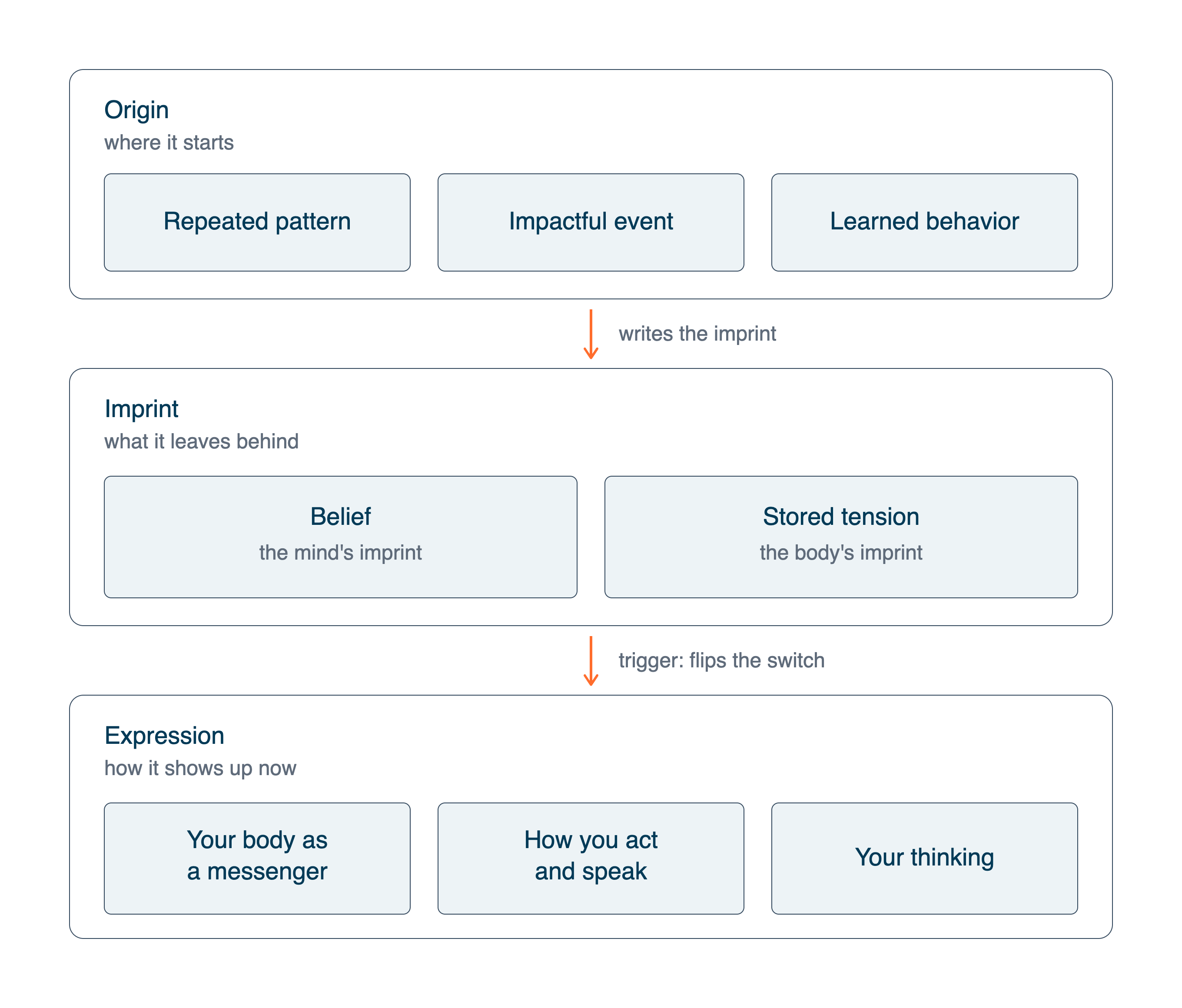
Origin: where it starts
An origin is the event or pattern that first sets things in motion. This is 'the thing that happened'. Not every origin looks the same. Broadly, there are three types worth telling apart.
A repeated pattern. This is something that happened over and over. Being constantly (positively or negatively) judged on performance, for instance, or consistently getting the sense that your feelings didn't matter. There is no clear start or end, just an atmosphere that accumulated over time.
An impactful event. This works differently from a repeated pattern as it doesn't need repetition to leave a mark. Unlike a repeated pattern, you can usually point to when it started and when it ended. It can be a single moment, like a harsh public criticism, being let down by someone you depended on, a sudden failure at something you'd invested heavily in. It can also be something that unfolded over a longer stretch, like an illness, a difficult period, a relationship ending. Severity here is relative to the person. Two people can live through the same event and walk away with very different imprints.
Learned behavior. This is what you picked up from the people around you, or implicit messages from your environment or culture. Examples are how your parents handled conflict, what your environment labeled as "weak" or "strong," what was implicitly approved of or frowned upon.
These three types don't rule each other out. For most people, more than one is at play at once, and a single impactful event can sit inside a broader repeated pattern that gave it its meaning. The word "trauma" often comes up in conversations like this, but whether something deserves that label isn't really the point. It's not about how severe your past was, it's about what you consciously or subconsciously started carrying because of it. That is where the imprint comes in.
Imprint: what gets left behind
An origin doesn't just happen and disappear. You 'learn' from it. It leaves an imprint behind, and it leaves it behind in two different places at once: in your mind, and in your body.
Belief, the mind's imprint. The origin often results in a set of conscious and subconscious beliefs, often without noticing you'd drawn it. These are conclusions about yourself, other people, or how the world works, Those beliefs decide, beneath your awareness, what you notice and what you don't. If you believe conflict is dangerous, you unconsciously scan for signs of conflict everywhere, and so you keep finding them. If you believe you have to do everything alone, you don't even register help when it's offered. Beliefs also work like a prediction system, preparing your body in advance for what's coming. If you believe things will fall apart without your involvement, your system stays on alert even in moments that don't actually need it, like when you need to sleep. In itself, a clever way to keep you safe. The problem is when that radar is still calibrated to a past, or to a conclusion that is no longer necessary.
Stored tension, the body's imprint. This works differently from a body signal in the present moment (more on that under Expression, below). Sometimes, when you felt something intensely but couldn't act on it, fight it or flee it, the reaction never got to finish. For instance, if someone was being harshly corrected in front of others at school, their body wanted to defend itself by saying something back or by leaving the room. Instead they just sat still. The urge to react never completed, it was a wave that never got to break. Instead of rising and releasing, it stayed stuck in the body as leftover activation, and their system kept unconsciously looking for a way to complete it. Years later, an unrelated situation could trigger a disproportionate wave of shame, a lump in the throat, or the urge to make themselves small, because that older, unfinished activation was still there, and this moment just opened the door to it. This is a model drawn especially from body-based trauma therapy, most associated with Peter Levine's work. When that stuck tension does get released properly, your reactions become less intense, and so does the self-sabotage built on top of them.
An impactful event often deposits both imprints at once: the belief is the conclusion your mind drew in that instant, the stored tension is whatever your nervous system didn't get to discharge during the event itself.
The imprint is usually the hardest part to deal with on your own, whether it's a belief or stored tension, because both operate beneath conscious awareness. It's not something you think, it's something that often happens subconsciously. But it's also where change ripples out the furthest. Shift a belief, or release stored tension, and situations suddenly look and feel different, opening up a whole new range of responses that no longer feel scary or forced.
Trigger: what flips the switch
An imprint can sit quietly for years without causing a problem, until something in the present activates it. That's the trigger.
An origin writes the imprint. A trigger doesn't write anything new, it just switches on what's already there. That distinction matters, because origin and trigger can otherwise look like the same category: both are "something that happened." The difference is when, and how often. An origin happens once, or a few times, in the past, and it's what the imprint is made of. A trigger happens now, and it can happen constantly. One belief that conflict is dangerous might get activated by a raised voice, a '.' at the end of a text message, a slow driver, or silence after you've spoken. That's why the same underlying issue can seem to show up everywhere. There's one imprint, but many doors that open onto it.
Expression: how it shows up now
This is the part you notice the most, in the moment, in real time. It's also where most attempts at change fail, because it's the easiest part to see and the hardest part to change on its own.
Your body as a messenger. Whatever is going on, it shows up somewhere in your body right now. In many cases, you're not even aware of these sensations yet. The ability to sense what's happening inside yourself is called interoception, and training this is one of the most useful things you can do to tackle self-sabotage. The build-up to a moment of self-sabotage happens in your body before it happens in your mind. Think, a tight chest, a knot in your stomach, restlessness in your legs, but also body language, how you're standing, whether your shoulders are raised, whether your jaw is clenched, whether you're avoiding eye contact, whether you've gone very still. All of this is different from stored tension. A racing heart before a hard conversation is your body reporting on right now; stored tension is a backlog from back then. Noticing present-moment signals early gives you a moment to pause and choose differently, instead of finding out only after you've already reacted.
How you act and speak. This is probably the part you most want to get rid of. It's how you act, or don't, when you'd actually want to do things differently. It includes what you do, and also how you speak: the tone you take, whether you go quiet, whether you over-explain or apologize before you've even said the thing, whether your words come out sharper or softer than you meant them to. How you act and talk is also what other people notice and give you feedback on: your partner, colleagues, your boss, friends. Behavior is the easiest thing to change, right here, right now. That doesn't mean the change is sustainable. If you only work at this level, installing habits, relying on willpower, it will cost you a lot of effort.
Your thinking. You know you're doing it, and you probably also know what you should be doing instead. That's the thinking level: the rational knowing, reasoning, working things out in your head. If knowing were enough to change something, the world would look very different. Same as with behavior, understanding something with your mind rarely changes it on its own.
How the three connect
Change that only touches expression, behavior, speech, or thinking, keeps costing energy. That's because you have to hold a habit against what's happening at the imprint level.
Understanding the origin of why you do what you do is helpful but not always sufficient to change the entire self-sabotage pattern. This is why, sometimes after years of therapy and knowing exactly why you feel the way you feel (origin-based work) you still don't do it differently.
Working on the imprint is the key. If you change the mind and/or body imprint, expression tends to shift on its own, without you having to force each part separately. Understanding the origin can definitely help you discover which subconscious beliefs are holding you back, but it's not an absolute must.
That doesn't mean you never need to work at the expression level. Sometimes a small behavioral change is what creates the room you need to reach the imprint underneath it. But if expression is the only thing you ever adjust, you're in for a tiresome ride, because the imprint that produced it is still fully intact, ready to start generating the next round of triggers.
Where to go from here
There's a good reason why you currently sabotage yourself in the way you do. And there's a way out of it. Behind every expression sits an imprint, and behind every imprint sits an origin that made sense at the time.
The next time you catch a pattern you don't like, use the framework itself as your question set.
> What's showing up right now, in your body, your behavior, your thinking?
> What just triggered it, a word, a look, a person, a deadline?
> And underneath that: is it a belief you haven't quite named, or a familiar unpleasant tension? That's usually where the actual leverage is.
You don't need to trace it all the way back to the origin to start there. Often the imprint already gives away more than enough. But if the same expression keeps returning no matter what you adjust at the surface, that's the signal to work a level deeper, not to try harder at the level you're already on.